14 January 2007

What Being a Christian Means To Me in My Field.

"PLEASE think about...what it means to be a Christian in your field AND IF AT ALL POSSIBLE write a paragraph or two with your thoughts. We will be using this as a point of reference during our time together. "

What follows is a modified and expanded version of an e-mail message I sent to my small group in California combined with a modified excerpt from my letter to Focus on the Family regarding Intelligent Design.

For the Christian, all experience, logic, and advice must be tested against the words of Scripture. I believe that Scripture endorses my calling to a position of academic excellence and influence with examples such as Daniel. Ideally, my work is described by Psalm 111:2, which says (in the NRSV), "Great are the works of the LORD, studied by all who delight in them."

I am a physicist, which means that I am a scientist. Science is a method of knowing about reality. It makes two assumptions. First, science assumes that the Universe is understandable to the human mind. Second, in order for experiment and observations to collect meaningful and consistent data with which to test hypotheses, the Universe must operate according to laws that are consistent through all space and time. We make this assumption implicitly with every step we take. We assume that every time we lift a foot off the ground, gravity will pull it back toward Earth with the same force as the previous step. I think these assumptions should be clearly stated and taught in all public school science classes. The second assumption was restated by Dr. Helen Quinn, a theoretical physicist, when she wrote that "the universality and immutability of the fundamental laws is the basic postulate of all science."

Personally, I believe that the assumptions of science are supported by Scripture. Psalm 111:2 celebrates the study of the great works of the Lord. If God had not given us the ability to understand his works, why would he direct us to study them? Furthermore, as a research scientist, I have the ability to know things about the Universe before any other mortal does; I can say with Kepler*, "O God, I am thinking Thy thoughts after Thee." The second assumption can be seen in Jeremiah 33:20, 25-26 when the Lord assures his people that that day, night, Heaven, and Earth all obey the "ordinances" and "fixed laws" he has established for them.

Jesus commands us to "Love the Lord your God with all your heart and with all your soul and with all your mind and with all your strength" (Mark 12:30), and Paul teaches us, "whatever you do, whether in word or deed, do it all in the name of the Lord Jesus, giving thanks to God the Father through him" (Colossians 3:17).

I believe that, in my vocation, I fulfill the these commands by using my mind to study the Lord's Creation, as I described above. If I do my research in the name of the Lord, that should motivate me to maintain high more, ethical, and technical standards. I must not idolize my accomplishments. Among other things, I must be forthright and honest about my faith, treat my colleagues with dignity and respect, give credit where credit is due, be scrupulously honest in my reports and publications, keep Christ as my first priority, and act with the knowledge that all of my words and deeds significantly impact the opinion my colleagues and advisers have of Christians and Christianity.

Jesus final words to his disciples were a command to "go and make disciples of all nations, baptizing them in the name of the Father and of the Son and of the Holy Spirit, and teaching them to obey everything I have commanded you" (Matthew 28:19-20). As we have discussed, many Christians are caused to feel that this Great Commission is best fulfilled by overseas missions work in hostile nations. Many of us who feel called to seek gainful employment outside of overseas evangelical missions tend to question and doubt whether our vocation is a legitimate one.

I have not known many missionaries (in the traditional sense), and I have only mustered the courage to speak to five about the questions and doubts I mentioned. They have, without exception, encouraged me to continue on my academic path. One woman, whose had moved from the suburbs to the inner city of Columbus, asked me to "please be a Physicist." A married couple of friends introduced me to Christian Aid Missions, an organization that believes people like us should send money to indigenous missions rather than going ourselves. An article in the introductory brochure that Christian Aid sent me is entitled "Thank you for Staying Home."

When I discussed my questions and doubts with a former missionary to Japan who is now part of an inner city Baptist church, she reminded me that as a Physicist, I had the ability to bring the gospel to large number of my colleagues who she could never even meet. The spiritual needs of scientists are often greater than those of people who are materially very poor. Also, if Christians did not enter fields that require intellect and rationality, the world could easily conclude that Christianity is inherently anti-intellectual and irrational. I believe the most important evangelical activity of my life is to offer living proof that a scientific, logical Christian can exist and thrive. Only after offering this proof can I make a convincing case against people like Richard Dawkins.


* Quoted in Charles E. Hummel, Galileo Connection: Resolving Conflicts between Science and the Bible (Downers Grove, IL: InterVarsity Press, 1986), 57; Frank S. Mead, ed. and comp., Encyclopedia of Religious Quotations (Old Tappan, N.J.: Revell, 1965), 176.

12 January 2007

"Church Shopping"

E-mail message from a friend

came across this article which articulates a lot of my discomfort with the way church is in the states.

and the ensuing discussion on the blog where i usually get my church news


Three quick replies
  1. When choosing churches in Ohio and California, I did "pray...about this decision" and "involve your small group" in that prayer and decision. I did "investigate the church's doctrine, history, or philosophy of ministry." I primarily investigated their theological soundness and service to the surrounding community. I admit that, in the case of my church here in Ohio, I did fail to uncover a few important theological views of the church."
  2. I agree with Pastor Jethani's assessment of the American church's conformity to a consumerist world view, and I am rather discouraged by it. However, she offers no real solution that I could find. She does not suggest any ways to transform the American Church into a more authentic and effective part of Christ's body. Many churches like within biking or walking distance of where I live; I must make a choice. Other than the questions I addressed in point 1, she offers no concrete advice on the correct way to make such choices.
  3. "According to Finke and Stark, the American church adopted a consumer-driven model because the First Amendment prohibited state-sanctioned religion." I think the First Amendment to the U.S. Constitution is an ally of Christianity. To understand my view, simply research the number of Christians in countries, such as Australia, the United Kingdom, and Italy, where a form of Christianity is the "state-sanctioned religion."

05 January 2007

I am from Wisconsin!

What American accent do you have?
Your Result: The Inland North

You may think you speak "Standard English straight out of the dictionary" but when you step away from the Great Lakes you get asked annoying questions like "Are you from Wisconsin?" or "Are you from Chicago?" Chances are you call carbonated drinks "pop."

The Midland

North Central

The Northeast

Philadelphia

The South

The West

Boston

What American accent do you have?
Quiz Created on GoToQuiz

Faith, Reason and the University

The Papal Address at the University of Regensburg on Sept. 12, 2006 caused much controversy around the world. A friend of mine sent me a link to this article. I wish the press had not focused on a single offensive quote at the cost of ignoring the Pope's excellent points. I have extracted several quotes and offer brief responses to them.

This address covered a wide range of issues relating to the influence of Greek culture and philosophy on Europe. One element of that influence was reason and its presence in the minds of God and his creatures. Early in the address he discusses conversation between "the erudite Byzantine emperor Manuel II Paleologus and an educated Persian on the subject of Christianity and Islam."

"Modifying the first verse of the Book of Genesis, the first verse of the whole Bible, John began the prologue of his Gospel with the words: 'In the beginning was the λόγος.' This is the very word used by the emperor: God acts, σὺν λόγω, with logos. Logos means both reason and word - a reason which is creative and capable of self-communication, precisely as reason. John thus spoke the final word on the biblical concept of God, and in this word all the often toilsome and tortuous threads of biblical faith find their culmination and synthesis. In the beginning was the logos, and the logos is God, says the Evangelist."

"A profound encounter of faith and reason is taking place here, an encounter between genuine enlightenment and religion. From the very heart of Christian faith and, at the same time, the heart of Greek thought now joined to faith, Manuel II was able to say: Not to act 'with logos' is contrary to God's nature"
The Christian God is, by his very nature, reasonable. Our faculties of reason come from him, and they should allow us some amount of understanding of him. Since he is infinite, he can never be fully comprehended by us, and we should not expect to predict or understand every one of his actions or commands.

However, I agree with the Pope, as quoted below, that we should not embrace the opposite extreme by believing that we cannot understand God at all. His faculties of reason should at least allow us to expect some level of consistency from him. If we cannot expect this, we have little basis for disagreeing with religious leaders who order ethnic cleansing, terrorism, or the burning of people at the stake.
"Here Khoury quotes a work of the noted French Islamist R. Arnaldez, who points out that Ibn Hazm went so far as to state that God is not bound even by his own word, and that nothing would oblige him to reveal the truth to us. Were it God's will, we would even have to practise idolatry."

"This gives rise to positions which clearly approach those of Ibn Hazm and might even lead to the image of a capricious God, who is not even bound to truth and goodness. God's transcendence and otherness are so exalted that our reason, our sense of the true and good, are no longer an authentic mirror of God, whose deepest possibilities remain eternally unattainable and hidden behind his actual decisions."

"Certainly, love, as Saint Paul says, 'transcends' knowledge and is thereby capable of perceiving more than thought alone (cf. Eph 3:19); nonetheless it continues to be love of the God who is Logos. Consequently, Christian worship is, again to quote Paul...worship in harmony with the eternal Word and with our reason (cf. Rom 12:1)."
In the sections of the address that I found most interesting, the Pope dealt with the limitaions and potential of science and reason as they relate to Christian faith. Near the beginning of the address, he stated that the "scientific ethos, moreover, is...the will to be obedient to the truth, and, as such, it embodies an attitude which belongs to the essential decisions of the Christian spirit." Science and Christianity should thus be quite compatible with each other. He proceeded to include two points about the Scientific Method.
"First, only the kind of certainty resulting from the interplay of mathematical and empirical elements can be considered scientific. Anything that would claim to be science must be measured against this criterion. Hence the human sciences, such as history, psychology, sociology and philosophy, attempt to conform themselves to this canon of scientificity. A second point, which is important for our reflections, is that by its very nature this method excludes the question of God, making it appear an unscientific or pre-scientific question. Consequently, we are faced with a reduction of the radius of science and reason, one which needs to be questioned....if science as a whole is this and this alone, then it is man himself who ends up being reduced, for the specifically human questions about our origin and destiny, the questions raised by religion and ethics, then have no place within the purview of collective reason as defined by 'science', so understood, and must thus be relegated to the realm of the subjective."
When I first read the quote above, I was worried that His Holiness intended to include supernatural phenomena within the realm of science. Science is powerful, but it is limited in scope. Supernatural beings and phenomena are not accesible to its methodology, and we scientists can only autoritativley speak about beings and phenomena that are understandible and accesible by the Scientific Method.

In the paragraph below, I think he makes a subtle distinction between the whole realm accessible by reason and the realm accesible by "scientific reason." The latter is a subset of the former. For example, as stated above, questions of destiny, religion, and ethics are not addressed by science, but they are still within the domain of human reason.
"In the Western world it is widely held that only positivistic reason and the forms of philosophy based on it are universally valid. Yet the world's profoundly religious cultures see this exclusion of the divine from the universality of reason as an attack on their most profound convictions. A reason which is deaf to the divine and which relegates religion into the realm of subcultures is incapable of entering into the dialogue of cultures. At the same time, as I have attempted to show, modern scientific reason with its intrinsically Platonic element bears within itself a question which points beyond itself and beyond the possibilities of its methodology."
That last sentece is extremely important to me as a Christian physicist. Science is by nature incapable of addressing many important questions of life. These questions tell me that I must look beyond science for the answers.

03 January 2007

Practical Benefits of Particle Physics #2

If you can read this, you have some level of access to the World Wide Web, which was invented by particle physicists at CERN in Geneva.

On the "Demotion" of Pluto


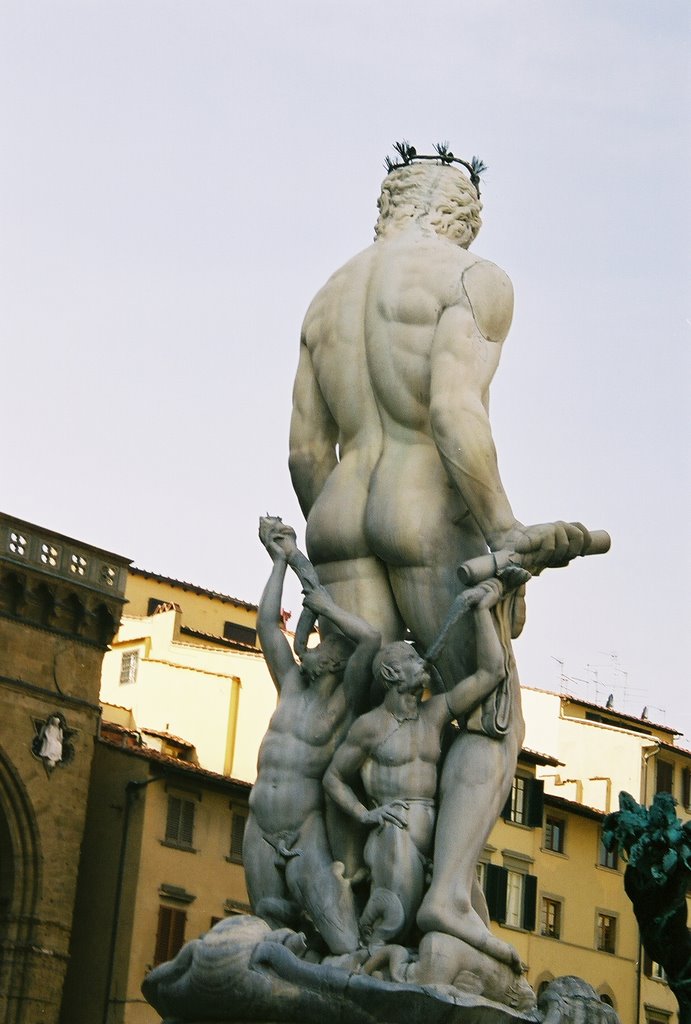
The "demotion" of Pluto from a planet to a "dwarf planet" by the International Astronomical Union has caused a surprisingly emotional reaction from the general public, including the California State Legislature. Some people feel as though a member of the family is being kicked out. While in Italy, I saw the statue of Neptune in the leftmost photograph above. I asked him what he thought about his planet being officially outermost due to Pluto's reclassification; he had no comment.

I think the reasons for reclassifying Pluto are scientifically sound, but I am not a planetary astronomer. Defining categories like this is usually difficult because God is not obliged to arrange nature in neat compartments. None of the objects orbiting our sun have the label "planet" written on them, so we must make the best choices we can about how to label them.

Let me suggest a new way to emotionally interpret the decision of the IAU. In 1930, the family of eight planets found an orphan wandering in the outer reaches of the known solar system. We adopted him, called him our ninth planet, and named him Pluto, but he always seemed different and out of place. Around the end of the 20th century, many more objects like Pluto were discovered in the same region of space. We began to realize that Pluto was more like these than like the other eight planets.

On August 24, 2006, the IAU decided that after 76 years, we had found Pluto's original family. The designation of Pluto as a "dwarf planet" does not mean we have kicked out a member of the family. We have merely reunited an adopted child with his true family.

This may all be excessively sentimental and anthropomorphic, but I think the analogy still works.

Happy New Year!

I know I am a few days late, but I have moved from California to Ohio and visited three states in between since Dec. 20. I have had a busy break!


create your own personalized map of the USA

More details will come, but I have successfully arrived back in Ohio and am settling into my new home and office.